|
THE OLD SCHOOL PRESS
An occasional newsletter about forthcoming
books and events |
|
January 2024 In this newsletter . . . progress on: Plates for a herbal offers on ex-display copies The Oxford Fine Press Book Fair 2023
|
|
THE OLD SCHOOL PRESS
An occasional newsletter about forthcoming
books and events |
|
January 2024 In this newsletter . . . progress on: Plates for a herbal offers on ex-display copies The Oxford Fine Press Book Fair 2023
|
|
progress on Plates for a herbal |
Work has started on this new book on the history of printing at Oxford University Press | |
|
Planned for summer 2024 |
| |
|
It was back in July 2022 that we gave a large hint about the possibility of this new book. We're pleased to announce that the project has now begun and we hope to be able to publish this important new title later this year. At the risk of boring regular readers I'll introduce the project again, briefly, firming up on some details, and then move on to early days in the printing. One of the themes of our output over the years has been the early and the twentieth-century history of printing at Oxford University Press. Plates for a herbal will be our tenth - and perhaps grandest - title in the series. OUP has a history going back into the fifteenth century but its history as a corporate body begins in the 1670s. One of its earliest publications was a herbal by Robert Morison titled Plantarum historiae universalis Oxoniensis, a fine folio edition intended to be in three volumes. The first published was volume two in 1680, on herbaceous plants, a volume containing 126 copper-engraved plates of botanical drawings, almost half by Michael Burghers, some of whose work for OUP we showed in Michael Burghers, Oxford engraver. The herbal has been the subject of extensive research and much background can be found here. One-time Press archivist Harry Carter reckoned the plates must have been 'the earliest of botanical subjects to be rendered by copper-engraving'. Those plates still exist. The title page of Morison's Herbal
We have been given permission by the Bodleian Library to take a limited number of pulls from twelve of the plates. The printing on the rolling/etching press is already under way by Jim Nottingham, who so expertly pulled the prints from the seventeenth-century plates in OUP's archives, engraved by Michael Burghers, that we showed in Michael Burghers, Oxford engraver. The plates in the Historiae are large – on average about 358 mm by 243 mm in size, or about 14 in by 10 in – so this will be a correspondingly large book. To complement the plates, five of which will appear in each copy, Professor Stephen Harris, Druce Curator of Oxford University Herbaria, has written about each from a botanical perspective. There will be essays from Scott Mandelbrote who gives an introduction to the original Historiae, and from Jim Nottingham who describes the plates themselves, how they have been prepared for use, and the process of printing from them. A sample opening from the original 1680 Herbal showing two plates
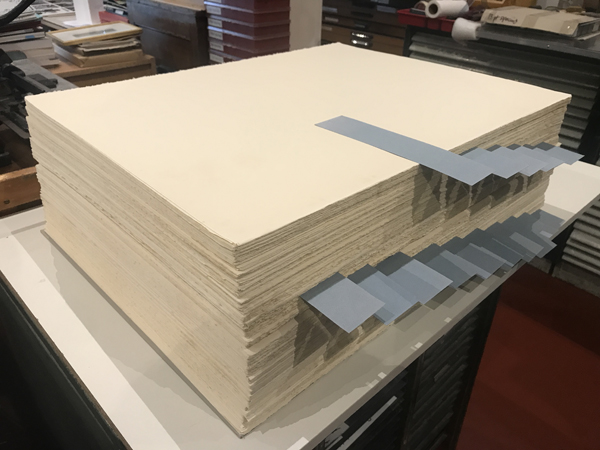
In the 1680s OUP sourced its paper principally from France, the standard of paper-making in England being so poor. For type it had at its disposal the matrices purchased in Holland by John Fell for similar reasons. For this twenty-first-century book we are printing the text on a full sheet of an antique Rives BFK laid paper (thus making a true Royal folio edition as the original), and hand-setting that text in Monotype Van Dijck; Jim Nottingham is printing the plates on a 250gsm Rives BFK paper. Our current expectation for the binding is as follows: the book will be quarter bound in faux vellum with a printed paper on the boards, and the plates will be loose in a portfolio, the book and portfolio resting in a cloth-covered solander box. To limit the use of these precious artefacts this will be a small edition - just 85 copies of which 75 will be for sale. Price to be determined. To be certain that the three reams of Rives BFK in our store will suffice I have carefully counted out the sheets: there are enough for a 64-page book with some spare in case of problems - 1,500 sheets. The reams concerned spent several decades in an unheated and probably rather damp room in the long-since closed printing house of St Hugh's Charterhouse before I acquired them; they are still in great condition though some sheets do show a little foxing and these I have put aside for proofing.
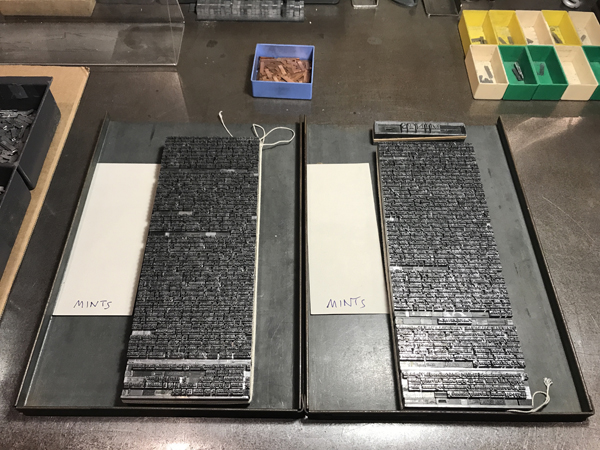
The text is being hand-set in a double column on the large sheet, 13/14 Van Dijck for the main text and 12/14 for the footnotes. Here is the type for the page that describes the plate for Mints, ready on two galleys.
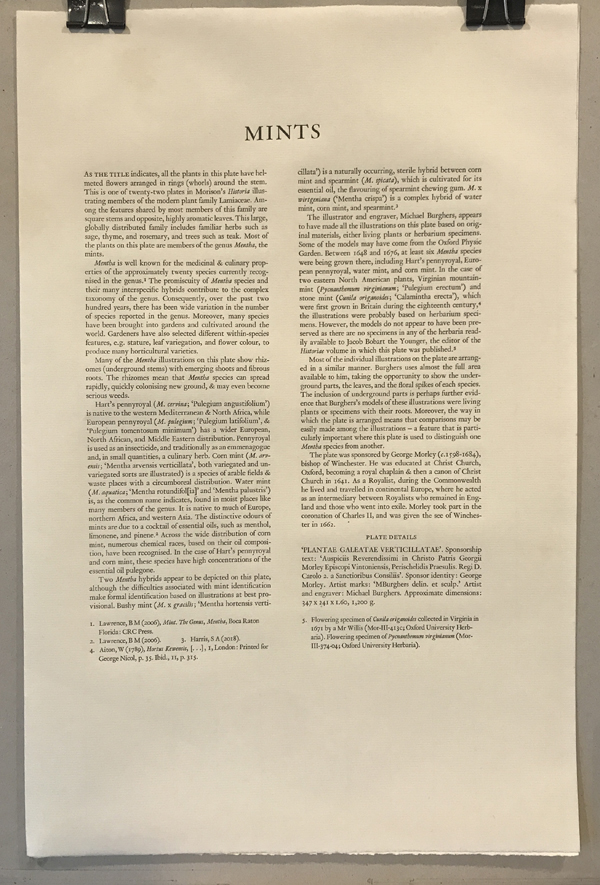
And here it is printed on the Rives BFK.
In a future newsletter I hope to cover Jim Nottingham's work on those important plates. | ||
|
Offers on ex-display copies |
||
| At nightfall on the shortest day |
| |
|
| ||
| Tonge's Travels |
|
|
|
| ||
| Antigone |
|
|
|
| ||
|
a reflection on The Oxford Fine Press Book Fair 2023 |
||
9-10 December 2023 |
||
|
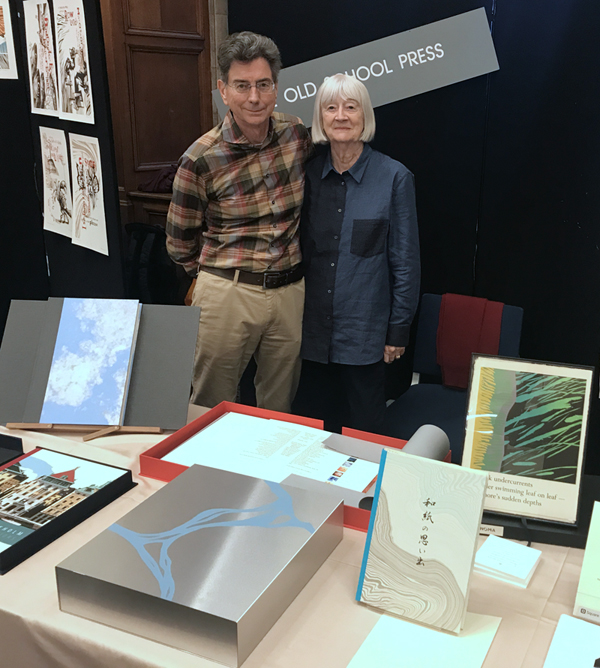
With Covid largely (but not entirely) in the rear mirror, the Oxford Fair goes from strength to strength in its new venue, the splendid Examination Schools in central Oxford. This is the second time it has been held there, organised and managed by the PBFA managers, Henry Gott and Siân Wainwright, to whom our thanks. It was the first outing for our two most recent books, Washi Memories by Eleanor Burkett and On Books by Simon Shorvon, both of which have been well received. And as ever we had a fine time catching up with our customers and fellow inky-fingered devotees of the printing art.
Our sign was meant to be like that . . . It made you look, didn't it? | ||
|
|
click to see an index of our newsletters
| |
|
Copyright © Martyn Ould 2024 | ||