|
A title from The Old School Press Plates for a Herbal Pulls from some of
the original copper engraving plates used for Robert Morison's Herbal of 1680 and 1699, with
expert commentary | ||
|
| ||
|
About the book Oxford University Press's history as a corporate body began in the 1670s when John Fell and three partners took over its management, funding the purchase of equipment and establishing it in its first (though short-lived) home in the Sheldonian Theatre. One of their earliest publications was Robert Morison's Herbal, properly titled Plantarum historiae universalis Oxoniensis, a grand folio edition intended to be in three volumes. The first published was volume two in 1680, on herbaceous plants, a volume containing 126 copper-engraved plates of botanical drawings, almost half by Michael Burghers, some of whose work for OUP we showed in Michael Burghers, Oxford engraver. The second volume published was number three, which appeared in 1699 with 166 plates. All but one of the plates from those two volumes survive in the Sherardian Library of Plant Taxonomy, Oxford, having been discovered acting as the counterweight in a lift in the Radcliffe Science Library. Twenty underwent conservation at the Bodleian Library and were found to be in perfectly usable condition. One of the themes of the output of The Old School Press has been the early and twentieth-century history of Oxford University Press. Plates for a Herbal is our tenth - and perhaps grandest - title in the series. We have been given permission by the Bodleian Library to take a limited number of pulls from each of twelve of the twenty conserved plates. The printing has been undertaken by Master Printer Jim Nottingham, who so expertly printed the seventeenth-century plates shown in Michael Burghers, Oxford engraver. The plates in Morison's Historiae are large – on average about 358 mm by 243 mm in size, or about 14 in by 10 in – so this will be a correspondingly large book. Each copy for sale contains new pulls from five of the twelve plates, randomly chosen. To complement the plates, there are a number of short essays. Cambridge historian Scott Mandelbrote provides an introduction to the original Historiae; Professor Stephen Harris, Druce Curator of the Oxford University Herbaria, has written on each of the twelve plates from a botanical perspective; and Jim Nottingham describes the plates themselves, how they have been prepared for use, and the process of printing from them. The title page of Morison's Herbal:
A sample opening from a copy of the original Herbal showing two plates:
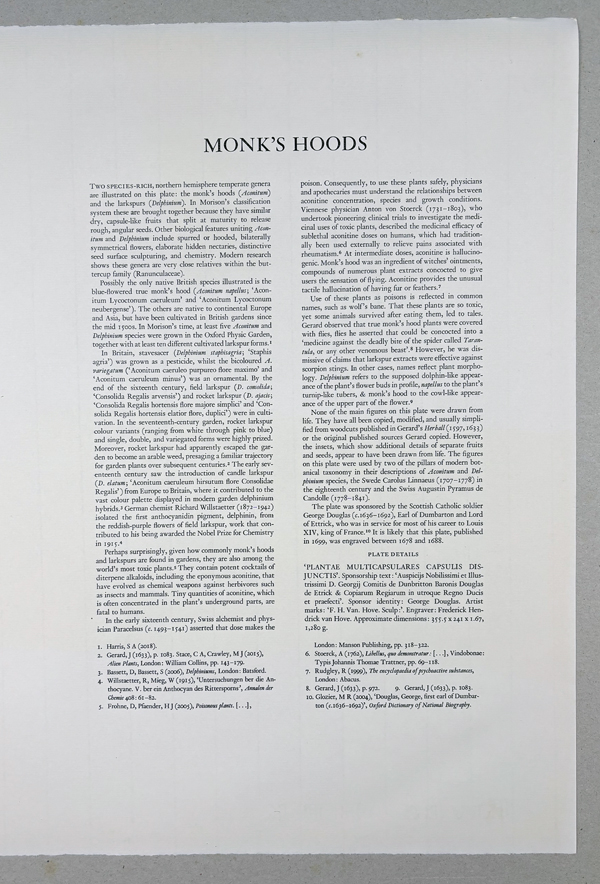
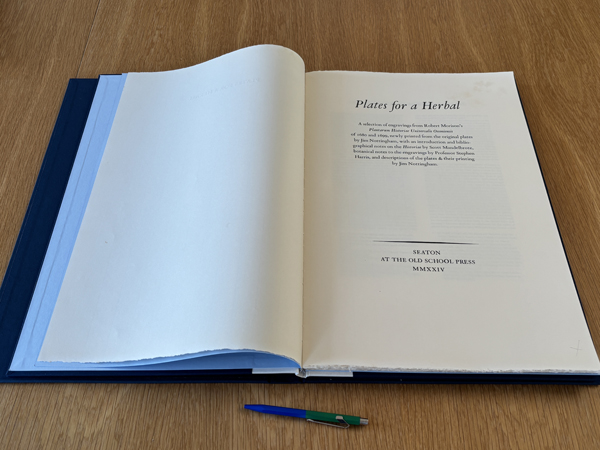
About the edition In the 1680s OUP sourced its paper principally from France, the standard of paper-making in England being so poor and on a relatively small scale. For type it had at its disposal the matrices purchased in Holland by John Fell for similar reasons. For this twenty-first-century book we printed the text in a double column on a full sheet of an antique Rives BFK laid paper (thus making a true Royal folio edition as the original), and hand-set that text in Monotype Van Dijck, 13pt for the main text and 12pt for footnotes. The images below show one of the plate descriptions by Stephen Harris, the title page, and an opening of two pages of Scott Mandelbrote's introduction.
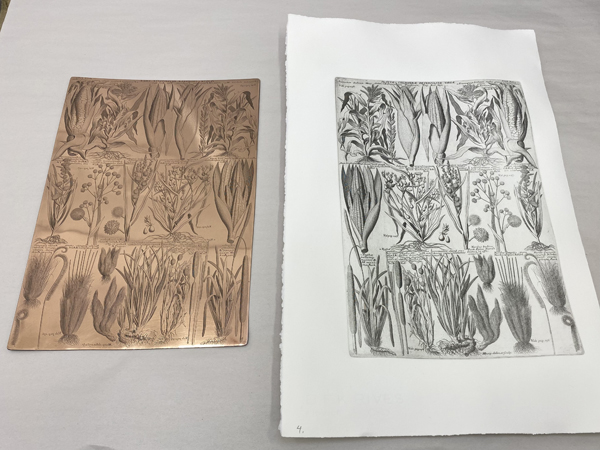
The plates are beautiful objects in their own right. Here is one that features in the book, alongside a pull freshly taken from it.
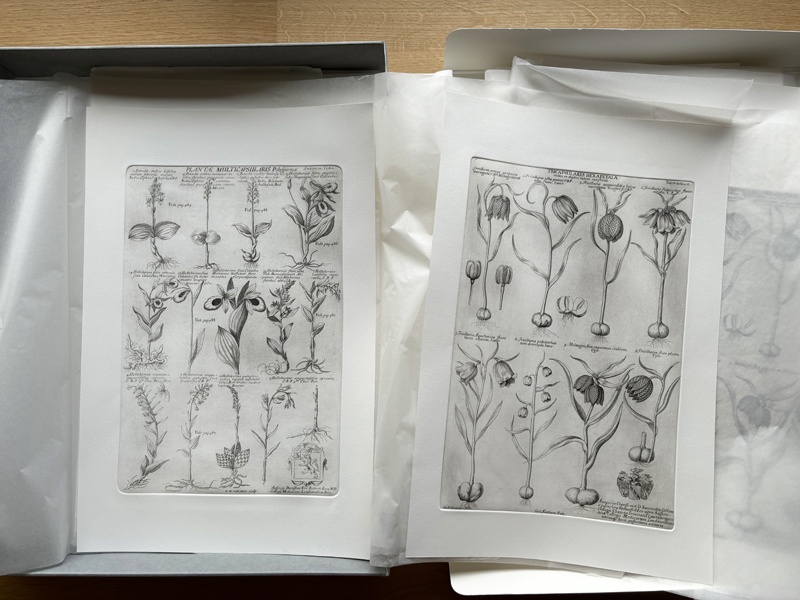
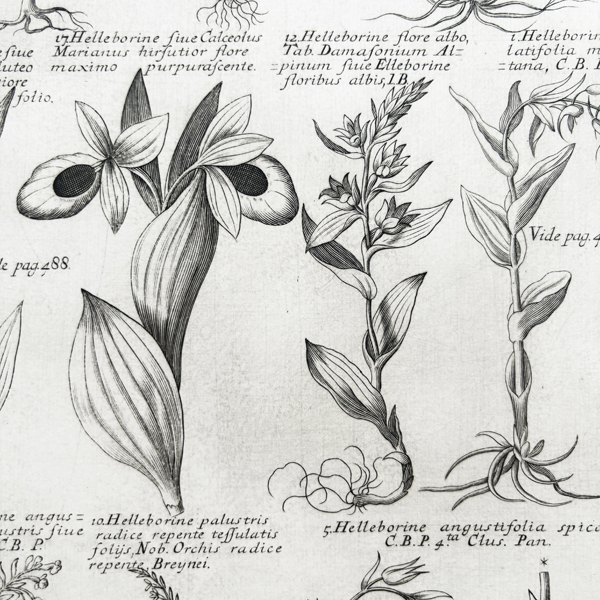
The plates have been printed on 250gsm Rives BFK paper. Below you can see the plate about orchids engraved by Frederick van Hove (1628-98) and another about fritillaries engraved by William Faithorne (c.1620-91). The detail image is taken from the orchids plate.
The binding is as follows: the book is bound in a dark blue cloth with the title debossed in silver on the front board, and it rests in a cloth-covered chemise at the back of which is a pocket containing five engravings and interleaving sheets. 64pp. Each copy of the book also contains an A4 booklet showing all twelve plates, digitally printed. You can watch progress on the book's making through our newsletters - use the 'progress' button at the top of the page which takes you to the start of work on the book. You can also watch a video of the whole process that Jim used to print from a plate. Taking just one 'pull' took a quarter of an hour, most of which is in the inking and preparation of the plate, prior to putting it through the rolling press with a dampened sheet of Rives. There are just seventy-six copies for sale. The price is £480 plus shipping. You can buy a copy at our online shop. | ||
|
| ||
|
Find out more about the book |
View a sequence of images of the book: |
|
|
Watch a short video of the book: |
| |
|
Watch a video of of Jim Nottingham printing one of the plates: |
| |
|
|
||
|
What others have said about the book |
'exceptional quality', 'magnificent!', 'a wonderful book', 'what a treat! -Plates for a Herbal is superb!', 'wonderful', 'fantastic', 'a tour de force', 'a magnificent piece of work . . . design, content, materials and production', 'another triumph', 'simply glorious piece of work', a truly stunning publication' |
|